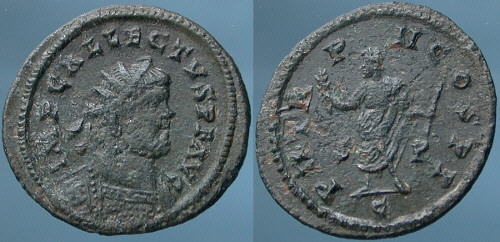
Allectus. 293–296 AD. Ae Antoninianus. IMP C ALLECTVS P F AVG. Radiate and cuirassed bust right. ® P M TR P II COS P P. Emperor standing left, holding olive branch and baton; S P in field; C in exergue. 22mm.
Antoninianus of Allectus, struck at the ‘C’ mint*. I believe this coin to be unique, as I and others can trace no other example. It is unlisted in the standard works, and of considerable numismatic interest.
RIC V (1933) states:
“No dated coins of Allectus are known, and he does not appear to have commemorated his
vota or assumed consular or tribunician power or the office of Pontifex Maximus.”
The present coin, which is of good style and appears to be an official product of the ‘C’ mint, establishes that Allectus did in fact assume both consular and tribunician power and also the office of Pontifex Maximus. As the coin denotes his second tribuniciate, it will date no earlier than the second year of his reign.
* The location of the mint indicated by the mintmark ‘C’, found on coins of Carausius and Allectus, is uncertain, but numismatic opinion favours Camulodunum (Colchester).
Many thanks to Rod Blunt for his help with this coin.
Academic Note:
The reverse type P M TR P II COS P P with mintmark C is unrecorded in all
standard references for the coinage of Allectus. RIC V, pt. 2 (1933), p. 456, notes that “no dated
coins of Allectus are known,” and that he is not attested as having assumed tribunician or
consular powers. The present specimen provides the first numismatic evidence for both titles
and, by its reference to TR P II, demonstrates that Allectus held the tribunician power at least
twice. No parallel is listed in Webb, The Reign and Coinage of Carausius (1908), Sear,
Roman Coins and Their Values, Burnett et al., Roman Provincial Coinage, or in any major
institutional or auction corpus. At the time of writing, this coin—now in the collection of the
British Museum—remains the sole known example of the type and should be regarded as
unique.